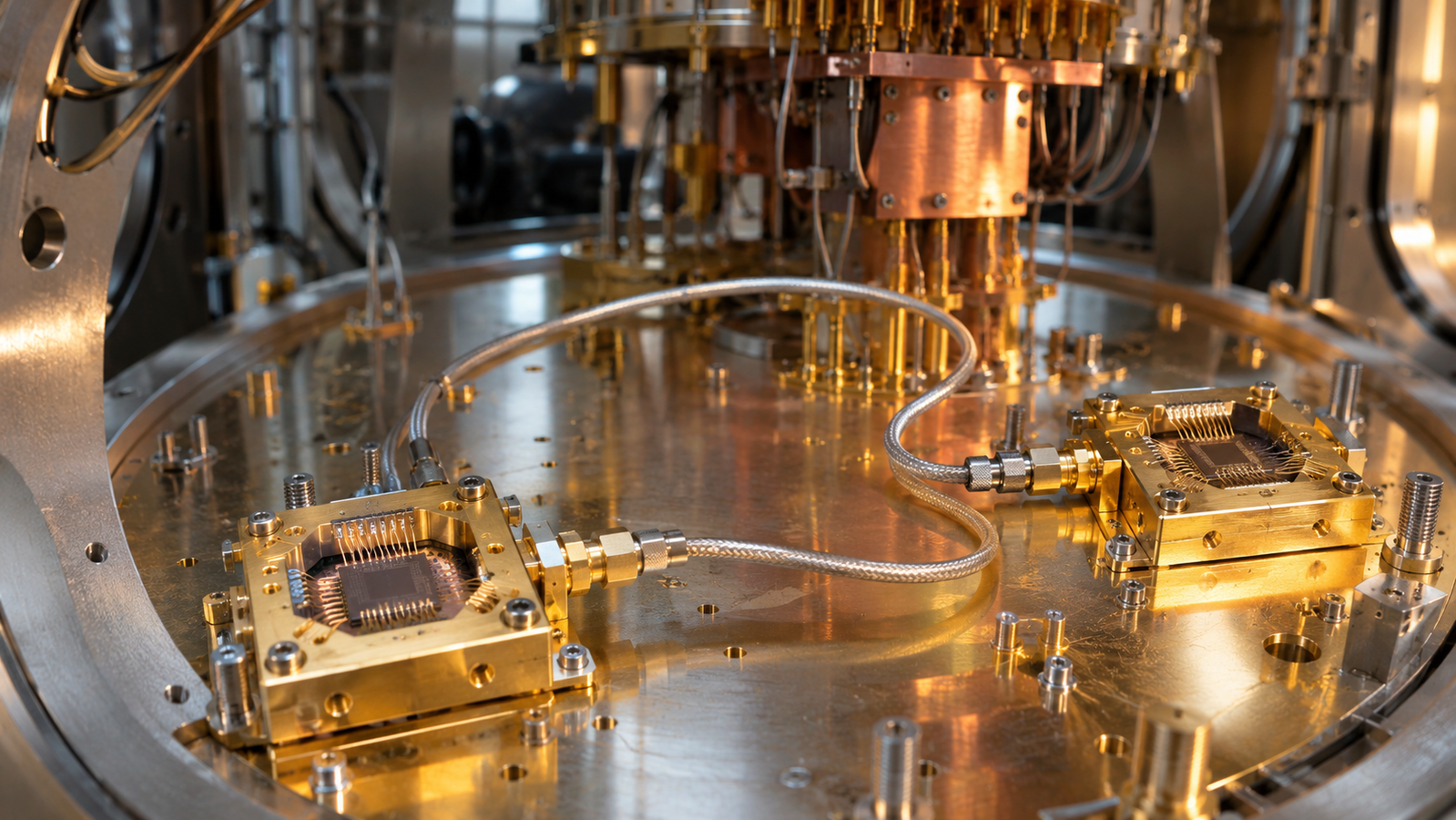
Un salto di qualità nel mondo dell’informatica quantistica. Ricercatori cinesi dell’Accademia cinese delle scienze sono riusciti a dimostrare una tecnica che trascende i limiti dei tradizionali bit quantistici (qubit), utilizzando stati di tre livelli chiamati qutrit. Questa rivoluzione è fondamentale perché apre la strada al trasferimento di informazione quantistica più densa e sofisticata tra processori separati. L’esperimento consiste nel collegare due chip superconduttori (che fungono da cuore dei processori) attraverso un cavo dedicato a microonde. I ricercatori non si accontentano di usare i soli due stati di base dei qubit; invece, sfrutteranno la capacità dei qutrit di combinare coerentemente tre componenti, conservando le relazioni di fase tra di essi. Per farlo, lo stato quantistico viene convertito in impulsi di fotoni a microonde, che viaggiano dal mittente al ricevitore. Il trucco sta nell’interfaccia: al ricevitore, un risonatore specializzato e un filtro Purcell permettono di ‘accordare’ la frequenza e la larghezza di banda per ricevere lo stato quasi perfetto. Dopo aver testato e calcolato con la tomografia quantistica, il gruppo ha raggiunto una fedeltà media impressionante per gli stati trasferiti, superando le aspettative. Non è solo questo: hanno anche dimostrato l’entanglement tridimensionale, confermando che tutti e tre i livelli partecipano alle correlazioni. Questo significa che, per il calcolo quantistico distribuito, l’interconnessione non è più un semplice accessorio, ma una risorsa da progettare con cura, elevando l’intero sistema a un livello superiore di complessità e potenziale.
🇬🇧 Summary in English
A major leap forward in quantum computing. Chinese researchers from the Chinese Academy of Sciences have successfully demonstrated a technique that pushes beyond the limitations of standard quantum bits (qubits), by leveraging three-level states known as qutrits. This breakthrough is crucial because it paves the way for transmitting denser, more sophisticated quantum information between separate processors. The experiment involves linking two superconducting chips (the functional core of the processors) across a dedicated microwave cable. The clever part? They aren’t just sticking to the two base states of qubits; they are tapping into the ability of qutrits to combine three components coherently, while preserving their phase relationships. To achieve this link, the quantum state is first converted into microwave photon pulses traveling from the sender to the receiver. The key engineering feat happens at the receiving end. A specialized resonator and a Purcell filter allow them to ‘tune’ the frequency and bandwidth perfectly to capture the state in near-perfect condition. After rigorous testing using quantum tomography, the team achieved an impressive average fidelity for the transferred states, exceeding previous benchmarks. Furthermore, they demonstrated three-dimensional entanglement, confirming that all three levels participate in the quantum correlations. This breakthrough suggests that, for distributed quantum computing, the interconnect is no longer a mere accessory, but a resource that must be designed with precision, elevating the entire system’s complexity and potential.
Leggi l’articolo originale su Tom’s Hardware IT →
Fonte: Tom’s Hardware IT | Argomento: Hardware & Chip
#tecnologia #innovazione #technews