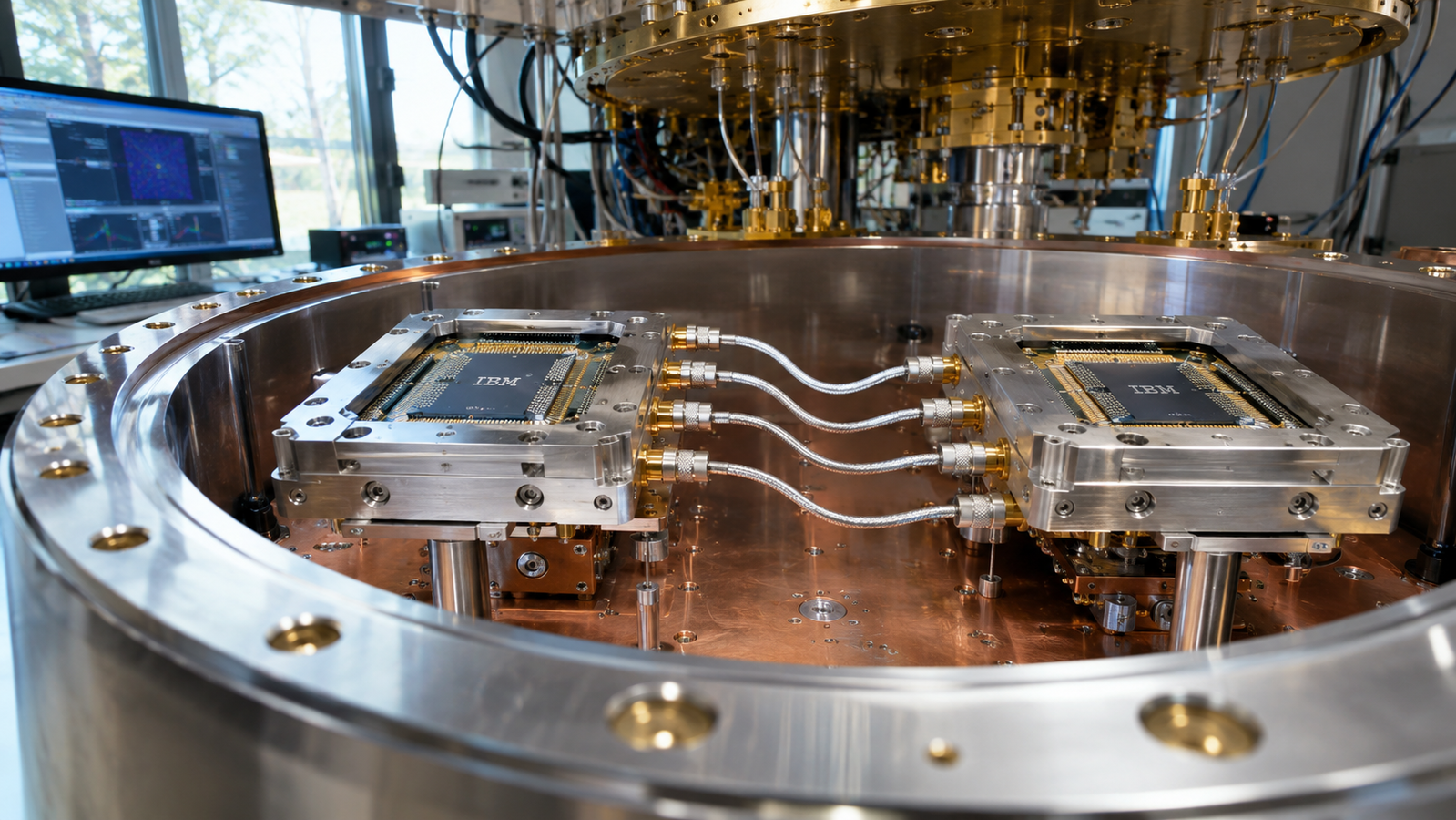
La computazione quantistica è spesso ritratta come qualcosa di unico, magari confinato in un singolo, massiccio processore. Ma cosa succede quando l’unica soluzione è fare un po’ di ‘patchwork’? Proprio questo è il giochetto che i ricercatori di IBM hanno messo in scena. Invece di riversare tutti i qubit su un unico circuito fragile, hanno collegato due chip quantistici (ognuno con 120 qubit) tramite ben quattro cavi superconduttori. Il trucco è gestire le ‘interconnessioni’, la parte più spinosa dell’hardware quantistico. Il concetto è quello di un’architettura modulare: un ponte per far comunicare i processori fra sé, mantenendo intatta la magia quantistica necessaria per calcolare. Questi collegamenti, chiamati L-couplers, non sono semplici fili; sono un capolavoro di ingegneria che si muove a temperature glaciali. L’informazione viene trasferita da un chip all’altro, superando non solo la distanza fisica, ma anche la fragilità dello stato quantistico. Inoltre, il team ha saputo non solo inviare i dati, ma anche generare entanglement tra i moduli separati, dimostrando che il ‘networking’ quantistico è fattibile. Sebbene sia ancora un esperimento (e un preprint, per essere precisi), questa dimostrazione è cruciale. Suggerisce che i computer quantistici del futuro non saranno un singolo oggetto da museo, ma piuttosto sistemi ampliabili, costruiti collegando moduli via via. In pratica, è il collaudo per creare mega-supercomputer quantistici, uno per volta, un cavo di rete alla volta. Il prossimo passo? Eliminare i glitch e prepararsi per la vera corsa verso la correzione degli errori su scala industriale.
🇬🇧 Summary in English
Quantum computing often sounds like this mythical beast living inside a single, monolithic machine. But what if the future isn’t about building one impossibly large chip, but linking many smaller, highly specialized ones? That’s the modular show put on by IBM Research. Instead of cramming all the qubits onto one fragile circuit, they connected two separate quantum chips—each sporting 120 qubits—using a quartet of superconducting cables. The real feat here isn’t the chips themselves, but the ‘interconnections,’ the trickiest part of quantum hardware. This experiment tackles modular quantum computing head-on: building larger processors by simply connecting smaller, independent units. The connections, dubbed L-couplers, are engineering marvels that operate at extremely cold temperatures. They manage to transfer delicate quantum states between the modules, ensuring the computational magic stays intact. The team didn’t just transfer data; they successfully generated entanglement and demonstrated parallel operations across the separated units. It’s like building a superhighway for quantum states. While this work remains preliminary (and admittedly a pre-print), the implications are massive. It suggests that the ultimate quantum computer won’t be a single object, but a scalable, interconnected network of modules. This breakthrough is key to creating massive quantum machines—one cable connection at a time. If they can refine this process and nail down the consistency and reliability across a wider range of qubits, we’re much closer to realizing the robust, error-corrected behemoths of tomorrow.
Leggi l’articolo originale su Tom’s Hardware IT →
Fonte: Tom’s Hardware IT | Argomento: Tech News
#tecnologia #innovazione #technews