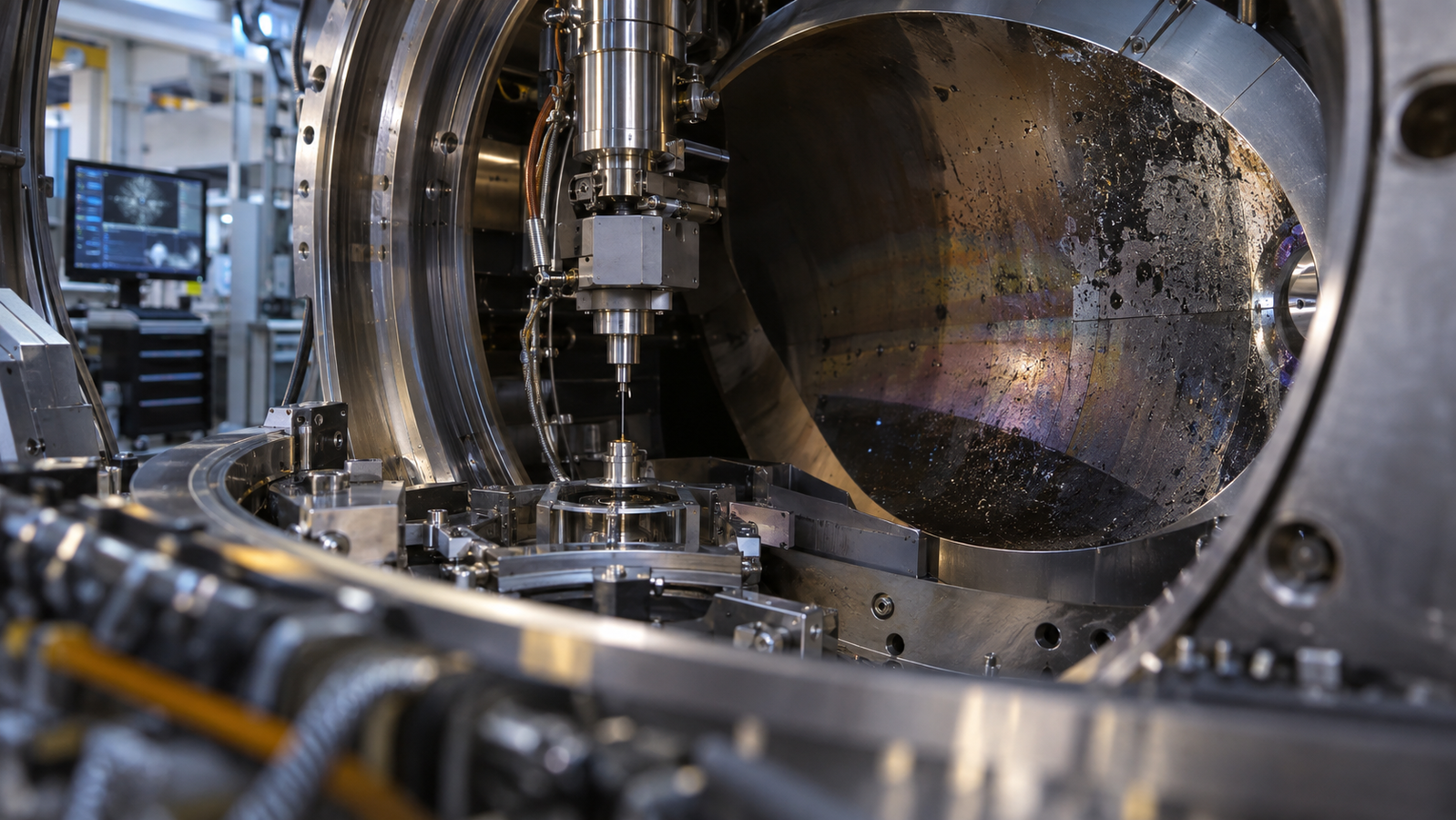
Il colosso ASML sta definendo la roadmap per la prossima generazione di macchine litografiche, e sembra che i laser a elettroni liberi (FEL), un tempo considerati i ‘miracoli’ del settore, siano stati messi sullo scaffale. L’azienda puntando tutto sul potenziamento delle attuali sorgenti al plasma (LPP), il metodo che finora ha reso possibili i chip sempre più piccoli. La litografia EUV, che trasferisce i circuiti sui wafer, si basa su un principio robusto: bombardare piccole gocce di stagno fuso con impulsi laser a CO₂ per creare plasma ionizzato, emettendo luce alla distanza magica di 13,5 nanometri. ASML vuole dare un’accelerata a questa tecnologia, portando la potenza dalle attuali 500 W ai prossimi 1.000 W, e quasi raddoppiando la frequenza di generazione delle gocce, arrivando a 100.000 al secondo. Questo richiede un sistema ottico sofisticatissimo, che, dato che l’UV estremo è un ‘anti-superpotere’ per la maggior parte dei materiali, deve operare nel vuoto e affidarsi a specchi riflettenti invece che a lenti convenzionali. I FEL offrivano vantaggi interessanti—eliminate le gocce di stagno e potenze EUV superiori—e un sistema di distribuzione della luce unico che avrebbe potuto alimentare più scanner da una singola sorgente. Tuttavia, l’implementazione tecnica dei FEL è un mostro di complessità: serve un acceleratore, una sorgente elettronica, un ondulatore gigantesco e una rete di gestione della potenza. Per renderli operativi, bisogna garantire continuità, efficienza e, soprattutto, un costo compatibile con il ritmo frenetico di una fabbrica di semiconduttori. Di conseguenza, pur essendo di enorme interesse per potenze globali come Cina, Stati Uniti e Giappone, i FEL non sono considerati pronti per il mercato nel prossimo decennio. ASML preferisce l’aumento progressivo delle performance sul plasma, un percorso più sicuro e maturo.
🇬🇧 Summary in English
ASML, the titan of chip manufacturing, has seemingly filed away the Free Electron Lasers (FEL) for its next-generation lithography machines. Instead, the company is betting its entire future on turbocharging the existing plasma sources (LPP), the method that has powered the miniaturization revolution. The core process—Extreme Ultraviolet (EUV) lithography—works by blasting minuscule droplets of molten tin with intense CO₂ laser pulses. This action creates ionized plasma, which then emits light at the critical 13.5 nanometer wavelength. ASML’s grand plan involves a massive power hike, boosting current sources from around 500 W up to 1,000 W in the coming years, while nearly doubling the droplet generation frequency to 100,000 per second. This technical challenge requires a marvel of engineering: the entire optical path must operate in a vacuum, relying on complex reflective mirrors rather than traditional lenses, since nearly everything absorbs deep UV light. While FELs offered enticing perks—getting rid of molten tin and boasting potentially higher EUV power—they also promised a novel architecture, allowing a single source to distribute light to multiple scanners. However, the sheer technical overhead of FELs is staggering: think accelerators, electron sources, massive undulators, beam control systems, and shielding. To be industrially viable, the system must achieve the continuity, efficiency, and cost profile of a mainstream semiconductor factory. Because of this immense hurdle, despite global interest from China, the US, and Japan, the full promise of FELs is estimated to be a decade or more away. ASML is therefore prioritizing a gradual, focused upgrade of its plasma technology—a path that, for now, offers more stability and operational maturity.
Leggi l’articolo originale su Tom’s Hardware IT →
Fonte: Tom’s Hardware IT | Argomento: Hardware & Chip
#tecnologia #innovazione #technews