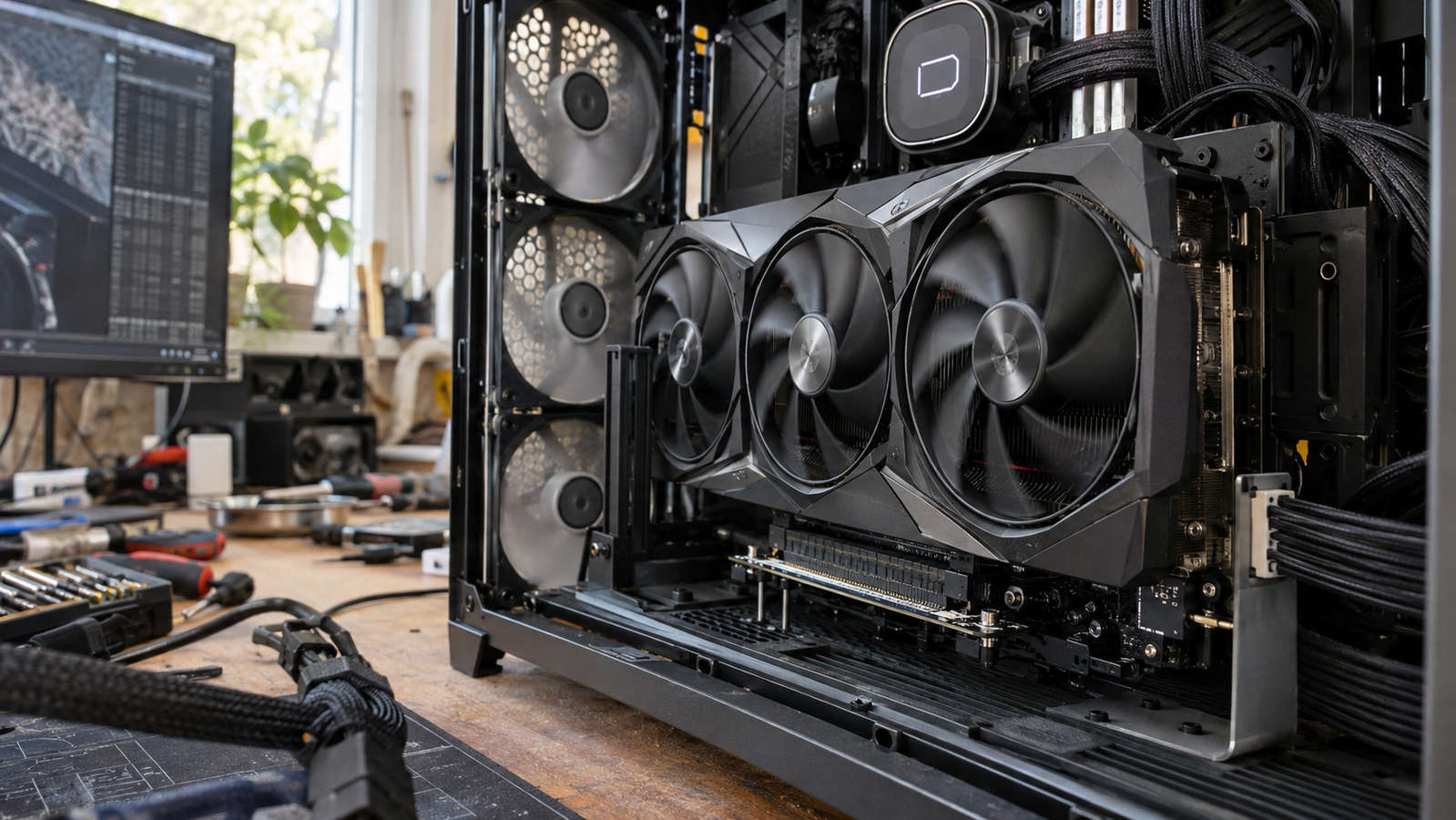
Sembra che l’hardware più potente del mondo possa subire i colpi di una cattiva architettura interna. TrashBench ha condotto un esperimento che ha messo in discussione l’approccio tradizionale al montaggio delle schede video, dimostrando che la vera battaglia per temperature basse non si vince solo con un dissipatore più massiccio, ma con la perfetta gestione dell’aria. Il test ha confrontato la configurazione standard, con la GPU montata orizzontalmente, con setup innovativi che alteravano radicalmente il percorso del flusso d’aria. I risultati sono stati notevoli: spostare la scheda video in una posizione che la collocasse subito a valle delle ventole di aspirazione ha generato un calo di temperatura dell’hotspot GPU ben superiore al 19°C. Il miglior risultato è stato ottenuto con un montaggio verticale, noto come ‘GPU Side Intake’, che ha fatto scendere la temperatura del core di ben 16,7°C. Non solo il chip grafico ha beneficiato magicamente di questo allineamento, ma hanno migliorato anche le temperature di VRAM e VRM, coinvolgendo componenti che spesso vengono trascurati. L’esperimento ha chiarito un principio fondamentale: l’ordine con cui l’aria incontra i componenti è cruciale. La differenza non sta solo in *dove* metti la GPU, ma *come* l’aria le arriva. Questi dati servono da un campanello d’allarme per tutti i modder che pensano che il solo installare un dissipatore gigantesco risolva tutti i problemi termici.
🇬🇧 Summary in English
It turns out that even the most powerful hardware can suffer from poor internal planning. TrashBench conducted a fascinating experiment that seriously questioned the conventional wisdom of GPU mounting, proving that the fight for optimal cooling temperatures isn’t just about bigger heatsinks; it’s all about mastering the airflow path. The test compared the standard, horizontal mounting setup with radically different, innovative setups that completely altered the air flow. The results were nothing short of dramatic: simply placing the GPU in a spot directly downwind from the intake fans slashed the GPU hotspot temperature by more than 19°C. The best outcome came from a vertical mounting style, dubbed ‘GPU Side Intake,’ which cooled the core temperature by a staggering 16.7°C. Furthermore, it wasn’t just the main chip that benefitted; both the VRAM and VRM components showed significant temperature improvements. The experiment revealed a fundamental principle: the *sequence* in which air hits components is everything. The difference isn’t just *where* you mount the card, but *how* the air reaches it. This data should serve as a massive wake-up call for all builders who assume that simply buying a huge cooler will solve all their thermal woes.
Leggi l’articolo originale su Tom’s Hardware IT →
Fonte: Tom’s Hardware IT | Argomento: Hardware & Chip
#tecnologia #innovazione #technews